

In January, I wrote about how the last 25 years have been filled with frightening headlines and yet, over that same period, patient investors who owned a diversified portfolio were rewarded for staying the course. Lo and behold, in February we entered a new conflict in the Middle East as the United States and Israel launched a large-scale air and naval campaign against Iran, code-named Operation Epic Fury. Thousands of targets have been struck, oil prices have spiked, pulled back, and continue to whipsaw, while the rest of the markets have lurched up and down in response.
Amid all of this, I am reminded of the line often attributed to the ancient Greek playwright Aeschylus: “The first casualty of war is the truth.” It’s a sobering thought, and not just for soldiers and spies in the fog of war. It matters for investors too because when the truth is cloudy, emotions rush in to fill the gap and making informed decisions can be exponentially more difficult. So, what are we confident in and what do we do with it?
The U.S. and Israel have spent weeks conducting one of the most intense air campaigns in the region in decades. Oil shipments through the Strait of Hormuz, a key chokepoint for global energy, have been significantly disrupted, and Iran has retaliated with missile and drone attacks on U.S. bases and energy infrastructure in neighboring countries.
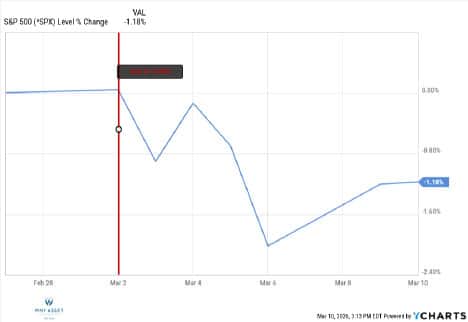
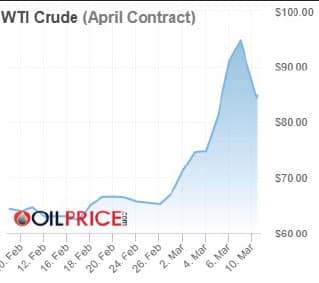
Not surprisingly, this directly impacted global oil prices, which initially surged toward $120 per barrel as traders feared a prolonged supply shock. In response, U.S. stocks sold off as investors worried about inflation, recession, and a replay of the “stagflation” narrative that is not all that far in the rearview mirror. Then, in classic market fashion, prices swung the other way after comments from President Trump suggesting the war might be “very much complete” or could end “very soon,” as oil dropped back into the mid-$80 range and stocks staged a strong rebound.
In other words, even in the first couple of weeks we have already seen big moves both down and up. That is the markets’ way of saying, “We don’t know how this ends yet.” And that is exactly the environment where Aeschylus’s line about truth becomes so relevant.
One of the hardest realities of war is that information becomes a weapon. Governments emphasize their successes, downplay their mistakes, and blame the other side for every tragedy. Media outlets, often working with incomplete or conflicting data, rush to fill 24-hour news cycles. Social media amplifies unverified claims at lightning speed.
As your advisor, our role is not to adjudicate war aims or media coverage. Our role is to separate the noise from what is financially actionable, because those are rarely the same thing.
In a conflict of this size, involving multiple countries and a critical transit route for ~20% of the world’s oil, it is helpful to zoom out and look at history to get an idea of what may happen:
- After Iraq invaded Kuwait in 1990, the S&P 500 dropped roughly 10–16% in the short term as oil spiked, but then rebounded strongly over the following year, rising around 20%.
- During the 2003 Iraq War, stocks were weak in the run-up to the conflict, but once the invasion began and some uncertainty cleared, the S&P 500 finished that year up about 26%.
- Looking across many conflicts, including the Gulf War, Iraq, and Russia’s various incursions, research shows that markets often experience a sharp initial shock, followed by a pattern in which returns over the next 6–12 months have tended to be positive more often than not.
Although the following chart is “busy,” it illustrates very nicely how many large global conflicts have happened and how, time after time, the market finds a way through.
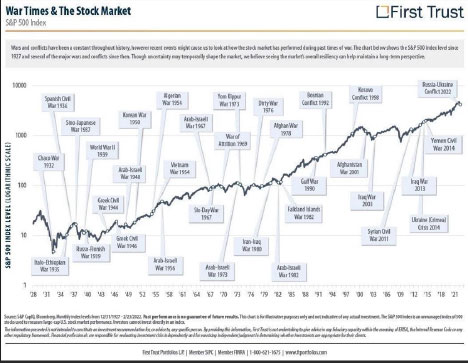
None of this guarantees a particular outcome. Every war is different, and past performance is never a promise of the future, but it does tell us that wars and scary headlines, by themselves, have not historically been a reliable signal to abandon long-term investment plans.
In fact, investors who tried to jump in and out of markets based on geopolitical news typically faced two very hard questions:
- When do you get out? At the first rumor? The first strike? The first drop?
- When do you get back in? After the “all clear” headline? After a ceasefire? After markets have already rebounded?
The current war has already rattled markets, but it does not change the basic fact that, over the long run, ownership of productive assets has outpaced inflation and cash.
As we move through this period of uncertainty, here is how I am thinking about portfolios and planning:
- Stay diversified. Concentrated bet, whether on a single region, sector, or “war winner” can backfire quickly. Diversification across asset classes and geographies remains our first line of defense.
- Use volatility, don’t fear it. For some portfolios, we will be looking to use market pullbacks to create opportunities for rebalance, harvest tax losses, or put new cash to work.
- Keep an eye on inflation, not just headlines. If energy-driven inflation does re-emerge, we will think about whether your current mix of growth assets, income, and cash still makes sense. We have research and technology to make changes to portfolios quickly.
Closing Thoughts
“The first casualty of war is the truth.” It is a reminder that, in times like these, we should be humble about what we think we “know.” The details of Operation Epic Fury, the ultimate political outcomes in Iran, and the exact path of oil prices, are all outside our control and, in many cases, beyond anyone’s ability to accurately predict in real time.
What we can control is how we respond:
- Whether we let each headline dictate our emotions
- Whether we abandon a well-built plan at the worst possible moment
- Whether we remember that behind every investment are real businesses solving real problems for real people
Our commitment is to keep watching the data, to separate out the noise, and to make decisions that reflect your goals, not the news cycle.