
Happy New Year! I hope you enjoyed a restful holiday season.
With a little downtime myself, I took a step back and reflected on 2025, another year that reminded us how unpredictable life, headlines, and markets can be. Personally, I’m grateful to say the year brought more blessings than setbacks.
That reflection also brought a broader perspective: we’ve now completed the first 25 years of this century, and it’s been anything but quiet. Naturally, it made me wonder if the last 25 years were this eventful, what might the next 25 hold?
And somewhere between that question and my recent watching of Charles Dickens’ “A Christmas Carol”, I found myself drawn into a thought experiment I’d like to share:
What if you knew?
So, travel back in time with me if you will. Imagine the clock strikes midnight and the new year of 2001 is rung in. Suddenly an Apparition appears to you and like Ebenezer Scrooge’s Ghost of Christmas Yet to Come takes you on a journey unveiling the coming quarter-century’s biggest news stories. The spirit shows you 9/11 and the 20+ years of military involvement in Iraq and Afghanistan. He opens the books on corporate scandals at Enron and WorldCom, the Subprime mortgage lending crash, the Global financial Crisis and Great Recession. He takes you “across the pond” where you see the European sovereign debt crisis and 2016’s Brexit turmoil. Back home you see the rise of high-frequency trading and subsequent “flash crashes” in the stock markets. He forces you to watch the COVID-19 pandemic, the social and economic lockdowns and market drop. Although you’ve seen enough you float over several metropolitan areas to view the domestic turmoil involving 15+ million citizens and billions of dollars of property damage. On your way to the other side of the globe your guide informs you that Inflation will surge to 40-year highs. At your last foreign destination, you hover high above Turkey where you can simultaneously see Ukraine to the North, and the largest conflict in Europe since World War II, as well as renewed violence in Israel to the South. As the tour ends the ghoulish figure returns you to the present, he foretells of 6 hotly contested Presidential elections, Gold moving from $265 to over $4,000 per oz. and the rise of internet money (cryptocurrency) all signaling a growing unease with the institutions and norms you knew just seconds earlier, on December 31, 2000
If you’d lived through that midnight tour, your first reaction probably wouldn’t be “How should I rebalance my portfolio?” It would be a gut-level mix of fear, disbelief, and the instinct to protect what matters most. And once the initial shock faded, a more practical question would surface: What do I do with this? Most of us would start tightening the belt, holding extra cash, avoiding risk, delaying big decisions, and “playing it safe”. Inevitably, that caution would find its way into your portfolio. Looking at the road ahead as it was just shown to you, would you still be able to invest with any real optimism?
Here’s the twist and the lesson that’s easy to miss in hindsight. All of it did happen. Yet alongside that very real history of crisis and uncertainty ran a parallel story that’s just as true: through three official U.S. recessions (2001, 2007–2009, and 2020), multiple bear markets, and repeated shocks to confidence, a disciplined, diversified mix of stocks and bonds still compounded wealth meaningfully over the past quarter-century. The world was noisy, frightening, and often unstable, but long-term investors who stayed diversified and stayed invested were rewarded (generic 60/40 Portfolio illustrated below).

The truth is growth doesn’t show up in a straight line. It comes in lurches, setbacks, and recoveries. It appears through fear-filled headlines and in uncertain moments when it would be easy to step aside. Growth takes root in silence and behind the scenes while fear is on display for all to see and feel.
The reason is quite simple and is the quiet story that rarely makes the front page: the resilience and creativity of the U.S. economic system.
Yes, we have a messy democracy. Yes, we have noisy media environment, and of course, we have plenty of policy and political disagreement. But we also have:
- Deep and liquid capital markets
- A culture that rewards innovation and risk-taking
- The ability for new companies and new technologies to disrupt the old
- A legal and property-rights framework that, while imperfect, is the envy of much of the world
This combination has allowed U.S. businesses to navigate everything from terrorist attacks to global financial crises to a worldwide pandemic, and still grow earnings, pay dividends, and innovate. The headlines chronicle the shocks, but market returns reflect a simple truth: millions of people getting up each day to build products, serve customers, and solve problems.
The key for long-term investors is not predicting each news story or even the short-term consequences of the events. It’s owning a share of that underlying human progress, and, crucially, staying the course long enough for compounding to work.
And knowing is half the Battle
So, if markets are volatile and the headlines are traumatic, why not be ultra conservative? The answer is a simple equation: Inflation + Growth = Necessity of Investments.
While Inflation doesn’t stand still, your savings can’t afford to, either. Over time, the U.S. money supply (what economists call “M2”) has grown dramatically (shown below). M2 now stands above $20 trillion, more than triple its level around the turn of the century. That growth isn’t inherently “good” or “bad”; it reflects credit creation, bank lending, and an expanding economy. But it does mean there are more dollars chasing goods, services, and assets than there used to be.

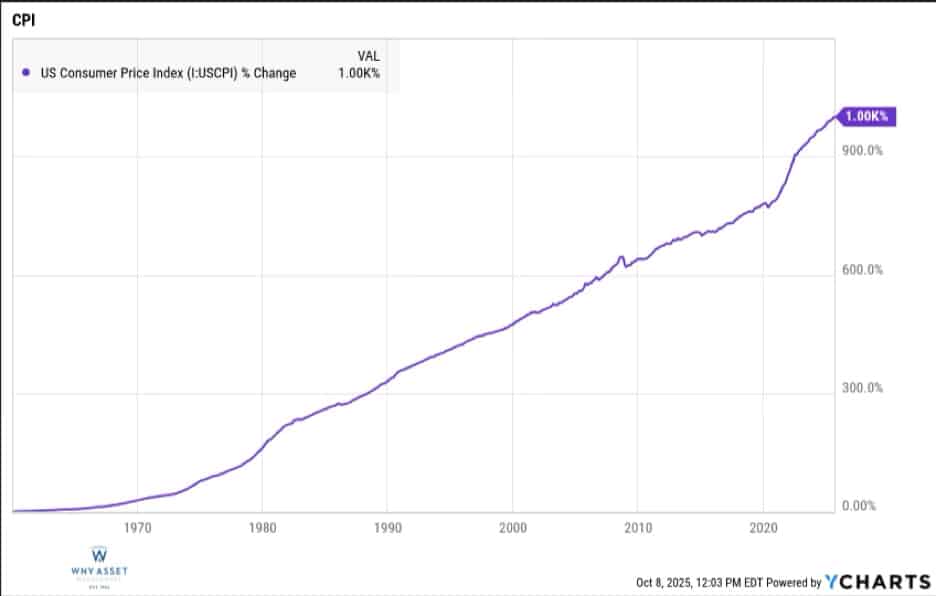
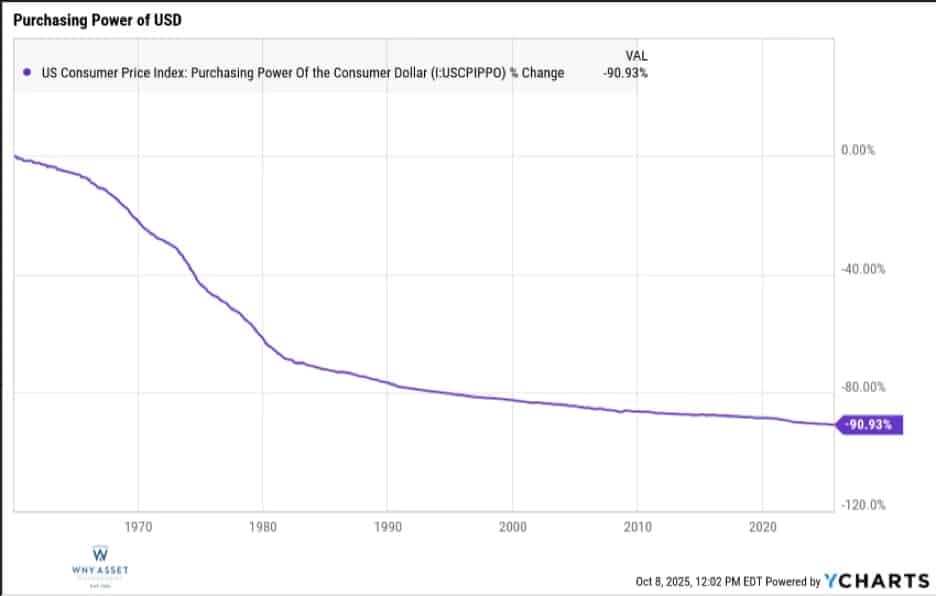
Meanwhile, inflation, the gradual rise in prices (and more pointedly, loss of your purchasing power) has averaged somewhere in the neighborhood of 2–3% per year since 2000, despite the recent spike. At 3% inflation, the purchasing power of a dollar is cut roughly in half over about 25 years (shown below).
Here’s what matters:
- If your money earns 0–2% in a savings account while inflation averages 3%, your real purchasing power shrinks over time. Your statement balance may not go down, but the number of groceries, hours of care, or travel miles it can buy quietly does.
- If your money is invested in productive assets ownership in companies, real estate, or other investments with the potential to grow faster than inflation, you have a fighting chance not just to keep up, but to get ahead.
Consider a simple illustration over 25 years:
- At 3% inflation, $100,000 of cash would need to grow to more than $200,000 just to buy the same basket of goods it does today.
- If that same $100,000 simply sat in a low-yield savings account, you might feel “safe,” but you would be slowly losing ground in real terms.
- In contrast, a diversified investment portfolio that earns something in the ballpark of the historic long-term returns (with ups and downs, and without guarantees) has had the potential to outpace inflation meaningfully over multi-decade periods.
This is why “I’m just going to stay in cash until things feel calmer” is so dangerous as a long-term strategy. There is always a reason to be nervous. If it wasn’t 9/11, it was the housing crash. If not the housing crash, then the euro crisis, or an election, or trade wars, or COVID, or inflation, or geopolitics.
The challenge is that while we wait for that elusive moment when “things feel safe,” three things tend to keep happening in the background:
- Prices keep rising, even when inflation isn’t making headlines.
- Innovative companies keep building value, often quietly, while markets work through the latest scare.
Over time, those who own productive assets participate in that growth. Those who remain exclusively in cash increasingly feel the squeeze of rising costs and missed opportunity.
Have a plan to Enjoy What’s Ahead
Looking back at the last 25 years, we see an incredible amount of disruption, fear, and uncertainty. But we also see:
- Three recessions that ended
- Multiple bear markets that reversed
- A U.S. stock market that, despite setbacks, rewarded patient investors willing to endure volatility
- A monetary and economic system in which sitting still and simply saving has not been enough to preserve purchasing power
The lesson we should draw from this history is not “ignore the news” or “markets always go up.” They don’t. The lesson is that you don’t need to predict each headline to be a successful investor, but you do need:
- A thoughtful, long-term investment plan tied to your goals
- A mix of assets designed for both growth and resilience
- A willingness to endure uncomfortable periods without abandoning the strategy
- An understanding that cash has a role for liquidity and safety, but is not a long-term growth engine
The system is far from perfect, but over and over again, its combination of free markets, legal protections, and entrepreneurial energy has helped investors overcome wars, recessions, and crises. The past 25 years are yet another chapter in that story.
As we begin 2026 our team remains here for you. Our job, together, is to make sure your financial strategy is grounded, patient, and positioned to turn long-term economic progress into long-term financial security for you and your family over the next 25 years and beyond.